

The Cullum Centre
The Cullum Centre programme has been established through a partnership between the Cullum Family Trust and the National Autistic Society (NAS), which began in 2012. Building on this partnership, the Cullum Centre at Alderman Peel High School (APHS) is our Autism Base – sometimes referred to as a Specialist Resource Base (SRB).
The Cullum Centre provides specialist autism support within APHS, enabling students to access learning, develop relationships and engage in wider school life through an individualised approach that recognises their strengths, differences and aspirations.
Our specialist support is underpinned by the APHS values of Ambition, Pride, Happiness and Success.
We help students to develop their potential and recognise personal success through:
- Learning, progress and personal achievement.
- Building positive relationships and social understanding.
- Developing responsibility and independence.
- Strengthening self-worth and a sense of belonging.
- Preparing for greater autonomy and life beyond school.
How are children supported through the Cullum Centre?
The Cullum Centre provides a consistent and predictable environment, with flexibility to respond to each student's individual needs. Support may include adapted timetables, curriculum adjustments, interventions, preparation for transitions and access to learning within the Cullum Centre when appropriate.
Students' progress, wellbeing and support needs are reviewed regularly, working in partnership with students, families and relevant professionals, including external professionals such as:
- Base advisor for Autism
- Link Educational Phycologist
- Specialist Partner
- NAS Educational Consultant
This ensures that provision remains responsive and supports students to develop confidence, independence and meaningful participation in school life.
Admissions
Alderman Peel High School Cullum Centre cannot discuss admissions suitability directly. Placements at the Cullum Centre are allocated through the Norfolk Local Authority admissions process. The provision is intended for students whose autism-related needs present barriers to accessing mainstream education and who may benefit from specialist SRB support.
Eligibility, suitability and placement decisions are considered through the established local authority process, including multi-professional panel consideration. Families should speak to the SENDCo at their child's current school for guidance on the referral and admissions process. For further information about the admissions process, please refer to this link:
https://www.norfolk.gov.uk/article/40747/Specialist-Resource-Bases-SRBs
Can I visit or have a tour of the Cullum Centre?
Tours of the APHS Cullum Centre take place each half-term for students and their families who have progressed through the admissions process to the panel stage. These visits provide an opportunity for families to familiarise themselves with the Centre, explore the environment and learn more about the support available. Families can ask questions and develop an understanding of daily life at the Cullum Centre.
Tours are intended to provide information and reassurance about the provision. Individual suitability and placement decisions are not discussed or determined during these visits, these are considered through the formal Norfolk Local Authority admissions process.
What is a day in the life of a Cullum student like?
The role of the Cullum Centre is not to create a separate Cullum Centre curriculum, but to provide the specialist teaching, adjustments and opportunities that enable each student to access an appropriate and meaningful curriculum. Accessing mainstream lessons remains the aspired offer of students’ day-to-day experience.
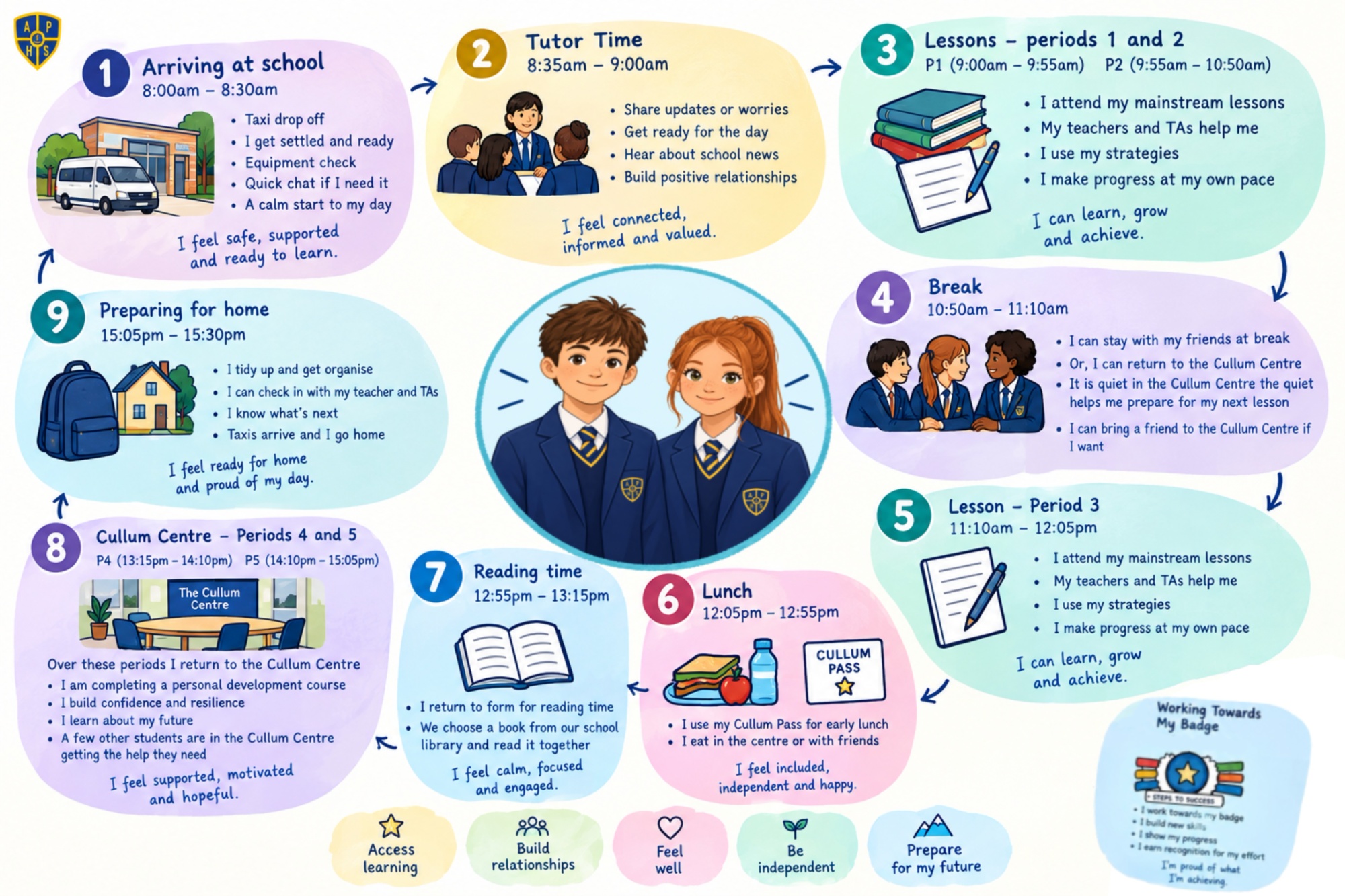
The student example above demonstrates how timetable experiences can be adapted to support specific student differences. It is important to note that the timetable examples below are illustrative and not fixed pathways. The balance of timetables is determined through individual assessment, student voice, strengths, needs, aspirations and progress.
|
Time |
Period |
Student A |
Student B |
|
8.00- 8.35am |
Soft landing - Welcome, equipment check/check in/readiness for the school day
Breakfast available from Canteen (8.15am) |
Student A is dropped off by taxi at the Cullum Centre. She visits the Cullum Centre this helps to regulate her |
Student B Walks to school and checks in with Cullum Centre staff briefly before meeting friend |
|
8.35- 9.00am |
Tutor time |
Student A registers with her tutor in the mainstream school |
Student B registers with his tutor in the mainstream school |
|
9.00- 9.55am |
Period 1 |
Student A attends her English lesson with her mainstream class |
Student B attends his English lesson with his Mainstream class |
|
9.55- 10.50am |
Period 2 |
Student A attends her Maths lesson with her mainstream class |
Student B attends The Cullum Centre for his Maths intervention - with TA support – this is an agreed timetabled adaptation |
|
10.50- 11.10am |
Break |
Student A quickly checked in at the Cullum Centre, and then returned to the playing field with friends to socialise |
Student B wanted to remain in Cullum Centre over break as he was enjoying the quiet |
|
11.10- 12.05pm |
Period 3 |
Student A attends her Geography lesson with her mainstream class |
Student B attends his Geography lesson with his Mainstream class |
|
12.05- 12.55pm |
Lunch |
Student A checked in at the Cullum Centre for 10 minutes, and then returned to the playing field with friends to socialise |
Student B wanted to remain in Cullum Centre for Lunch. Student B ate his lunch in the Cullum Centre whilst reading his book |
|
12.55- 13.15pm |
Tutor reading time |
Student A registers with her tutor and completed reading time with her form |
Student B registers with his tutor and completed reading time with his form |
|
13.15- 14.10pm |
Period 4 |
Cullum intervention;
Emotional literacy for example |
Cullum intervention;
Self–Advocacy for example |
|
14.10- 15.05pm |
Period 5 |
Student A attends her Art lesson with her mainstream class |
Student B attends his Art lesson with his Mainstream class |
|
15.05- 15.30pm |
Prepare for home – taxi home
Homework/next day preparation |
Student A returns to the Cullum Centre and discussed Maths homework
Waited for and left in her taxi. |
Student B returns to Cullum centre discussed and practiced Maths homework
He then walked home as usual. |
|
Time spent |
|
|
|
In Cullum Centre |
|
|
Not in Cullum Centre |
Frequently Asked Questions - Referrals and Placement
The Cullum Centre at Alderman Peel High School (APHS) is our Autism Base – sometimes referred to as a Specialist Resource Base (SRB).
1. How can my child be referred to the Cullum Centre?
A referral to the Cullum Centre is made through the Norfolk Local Authority referral process.
The referral is normally made by your child’s school SENCO or, where appropriate, the professional coordinating their Education, Health and Care Plan (EHCP).
Parents and carers cannot make a direct referral themselves, but your views are an important part of the process. Your child’s school should discuss the referral with you and seek your agreement before it is progressed.
2. Who decides whether an Autism Specialist Resource Base (SRB) is suitable for my child?
Each referral is carefully considered by professionals from the Local Authority for the nearest SRB.
Initially, the information provided is reviewed to decide whether the referral should proceed to an admissions panel. The admissions panel then considers the available information and decides whether a place at a Specialist Resource Base is appropriate.
The decision is based on your child’s individual needs, strengths, circumstances and the support they require, rather than simply on an autism diagnosis.
3. Will I be involved in the admissions process?
Yes. Your views and your child’s views are important.
Your child’s school will gather information about their needs, strengths, experiences and the support that has already been provided. Your views about your child and their education should also form part of the referral information.
You should be kept informed by the referring school or EHCP coordinator about the progress and outcome of the referral.
4. What information is considered as part of a referral?
The admissions process considers a range of information to build a clear picture of your child. This may include:
- their EHCP, where they have one
- information about their strengths, needs and areas of difficulty
- their current attainment and progress
- information about attendance
- their current timetable and provision
- reports or advice from professionals, such as Educational Psychologists
- information about communication and sensory needs
- information about emotional wellbeing and regulation
- support and strategies that have already been tried
- information about what has helped and the impact of that support
- any relevant medical or safeguarding information
- your views and your child’s views
- information explaining why an Autism Specialist Resource Base is being considered.
The purpose of this information is to understand what your child needs to access education successfully and whether the SRB can provide the right support.
5. What happens once a place has been agreed?
The referring school or EHCP coordinator will be informed of the outcome.
If a place is offered and accepted, the Cullum Centre Lead Teacher will then work with your child’s current school and your family to plan their transition.
This will include agreeing appropriate arrangements for your child to become familiar with the new environment, staff and routines before they start.
6. Who will contact me about my child's transition?
Once a place has been accepted, the Cullum Centre Lead Teacher will contact you and your child’s current school to begin planning the transition.
The transition will be personalised to your child. This may include visits to the Centre, opportunities to meet staff, familiarisation with the school environment and other arrangements that will help your child feel prepared.
7. Who decides what my child's timetable will look like?
The Cullum Centre Lead Teacher will develop an initial timetable in consultation with the relevant specialist professionals.
The timetable will take account of your child’s:
- strengths and interests
- learning needs
- communication and sensory needs
- emotional wellbeing
- EHCP outcomes
- current levels of independence
- readiness to access different parts of the mainstream school.
The timetable can be adapted as your child becomes more familiar with the school and their needs develop.
8. Will my child attend mainstream lessons?
The Cullum Centre is designed to support students to access their mainstream school environment wherever this is appropriate for them.
The amount and type of mainstream access will therefore be individual to each student. It may change over time as their confidence, skills, independence and support needs develop.
Decisions about mainstream access are made collaboratively by the relevant school and specialist professionals, with the student and their family involved in the process.
9. Who decides how much support my child needs?
Support is based on your child’s individual needs rather than a fixed amount of time or a standard package.
The Cullum Centre team will work with relevant professionals, your child and your family to understand what support is needed for your child to participate, learn and develop their independence.
Support will be reviewed regularly and adjusted when necessary.
10. Will my child have an individual support plan?
Yes. Following admission and transition, the Cullum Centre Lead Teacher will develop an initial support plan.
This brings together information from your child’s EHCP, referral, observations, professional advice and the views of your child and family.
The plan will identify areas such as:
- your child’s strengths and interests
- their individual outcomes
- barriers to learning and participation
- communication needs
- sensory needs
- emotional regulation and wellbeing
- strategies that help your child
- appropriate access to mainstream lessons
- ways of developing independence.
The plan will be reviewed and adapted as your child develops.
Accordion Title 11. How will my child's communication needs be understood?
We will develop an individual understanding of how your child communicates their needs, wishes, thoughts and feelings.
This may include spoken language, visual supports, communication systems, AAC or other ways of communicating.
The aim is to make sure that the adults working with your child understand how they communicate and make appropriate adjustments so that your child can communicate as successfully and independently as possible.
12. How will my child's sensory needs be understood?
Sensory needs are different for every child.
The Cullum Centre will work to understand your child’s individual sensory experiences, including what environments, activities or situations they find comfortable or difficult.
This information will help us identify appropriate environmental adjustments and strategies to support your child to feel comfortable, regulated and ready to learn.
These strategies will be reviewed regularly rather than treated as a fixed set of interventions.
13. How will my child's emotional wellbeing and regulation be supported?
We will work to understand what helps your child feel safe, understood, settled and ready to learn.
This may include looking at:
- communication
- relationships with trusted adults
- transitions and changes
- the school environment
- sensory experiences
- early signs that your child may be becoming overwhelmed
- strategies for regulation and recovery.
Support will focus on being proactive and preventative, rather than simply responding when a child is already distressed.
Where appropriate, an individual regulation or exit plan may also be developed.
14. How will my child's EHCP outcomes be incorporated?
Your child’s EHCP provides important information about their identified needs and outcomes.
Their progress towards these outcomes will be considered as part of regular planning and review. The Cullum Centre team will work with the relevant professionals and your child’s school to ensure that provision continues to reflect their needs.
Where appropriate, EHCP outcomes and provision will also be reviewed through the statutory EHCP Annual Review process.
15. How will you decide which interventions or additional support my child will need?
Support and interventions will be selected according to your child’s individual needs and agreed outcomes.
The Cullum Centre team will use information about what your child needs, what has already been tried and what has been effective.
Where appropriate, specialist advice will also inform decisions about support.
Interventions will be reviewed to make sure they remain useful and continue to support your child’s development and independence.
16. How will I know if my child is making progress?
Progress is considered in a number of ways.
This can include:
- academic progress
- progress towards EHCP outcomes
- development of independence
- communication and social participation
- emotional wellbeing and regulation